
HTX301 PCIe Accelerator · 1 Card, 4 Sets
Trillion-Parameter-Class AI Inference, On-Premise.
One HTX301 PCIe card carries four decode-first HTX301 chips — four sets on a single card.
Eight cards in one air-cooled server give up to 2 TB of onboard DRAM: enough to run Kimi K3 (2.8T) inside infrastructure you own, with model weights, prompts, and data never leaving it.
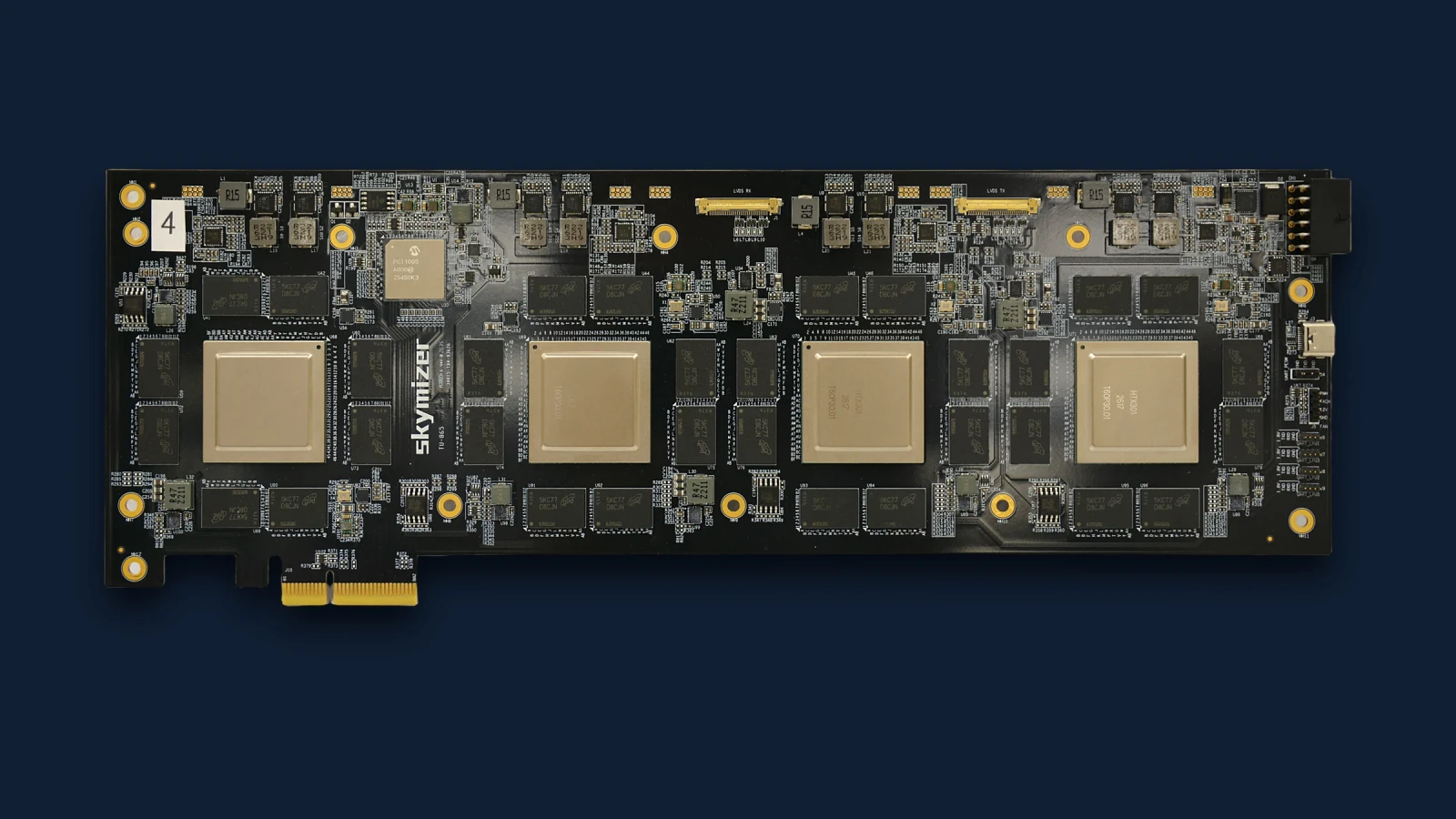
- 1 Card, 4 SetsFour HTX301 chips per PCIe card, each its own PCIe device
- 128 / 256 GBOnboard DRAM per HTX301 PCIe card
- Up to 2 TBOnboard DRAM across 8 cards in one air-cooled server
- >1T – 2.8TComing next: model range for the next configuration
Card-level figures. Model capacity is configuration-dependent and varies by model architecture, precision/quantization, software release, and system design.
The market shift
AI Infrastructure Is Changing
Training created the first generation of AI infrastructure. Inference will define the next.
Enterprise AI increasingly means continuous model execution across private assistants, RAG systems, coding copilots, multimodal applications, and AI agents. These workloads introduce a different set of requirements: model capacity, memory bandwidth, token-serving efficiency, latency, data sovereignty, and predictable operating cost.
Skymizer is rebuilding the AI stack around those requirements.
Purpose-built for the economics of serving AI — not repurposed from training.
Product portfolio
One Inference Foundation. Multiple Paths to Market.
HTX301
On-Premise AI Inference Accelerator
The first silicon implementation of HyperThought™ — a decode-first inference accelerator that brings large and ultra-large model inference inside enterprise-controlled infrastructure. It scales from practical single-card deployments to high-capacity custom systems and Mini Data Center clusters.
- Up to 512 GB model memory per high-capacity configuration
- Up to ~1-trillion-parameter-class model capacity
- Standard 1S / 4S · custom 8S configurations
- HyperThought™ + LISA™ v3
HyperThought™
Decode-First LPU Platform IP
Skymizer’s long-lived inference architecture and licensable LPU platform — decode-first hardware, the LISA™ instruction set, compiler and runtime technologies, memory optimization, and scalable workload orchestration in one software-hardware co-designed platform. Partners use it to build custom AI SoCs, accelerators, appliances, and infrastructure platforms.
Explore HyperThought →On-device IPEdgeThought™
Efficient Generative AI at the Edge
Skymizer’s compiler-centric LPU IP for resource-constrained on-device AI. It enables semiconductor and device partners to bring private, responsive generative AI into automotive, embedded, industrial, robotics, consumer, and edge-computing platforms.
Explore EdgeThought →Why decode-first
Built for the Inference-Dominant Era
Large-model serving is not only a compute problem. During decode, models repeatedly access weights and KV-cache state while generating tokens continuously — so memory capacity, bandwidth, data movement, power, and latency become first-order system constraints. HyperThought and HTX301 are architected around them.
Decode-First Architecture
Purpose-built around the sustained token-generation phase of AI inference.
Scalable Model Capacity
Scale compute and memory around the model — from compact deployments to high-capacity systems.
Enterprise Control
Keep model weights, prompts, data, policies, and outputs inside infrastructure the organization owns.
Predictable, Owned Economics
Move suitable workloads from variable per-token cloud consumption toward owned inference capacity with more predictable TCO.
Flagship silicon
Trillion-Parameter-Class Inference. On-Premise.
HTX301 brings HyperThought into silicon. The platform supports configurations scaling up to eight inference chips and up to 512 GB of DRAM per accelerator, enabling trillion-parameter-class model capacity without requiring GPU rack-level infrastructure for supported workloads.
- 1–8 ChipsPublic platform scaling capability
- Up to 512 GBConfiguration-dependent accelerator memory
- Up to ~1TModel capacity by architecture, precision & config
- PCIe-BasedEnterprise server & system integration
Scale story
From Edge AI to Mini Data Center
The same HyperThought architecture scales across deployment environments.
- Stage 1
Edge AI / AI Box
Deploy a single HTX301-based system close to the application or data source.
- Stage 2
Enterprise On-Premise
Integrate HTX301 into enterprise servers and private AI infrastructure.
- Stage 3
On-Premise Rack
Scale capacity across multiple accelerators and systems as workloads grow.
- Stage 4
Mini Data Center
Interconnect heterogeneous compute nodes and expand inference capacity without rebuilding the architecture.
Heterogeneous AI
Use the Right Hardware for Each Phase of Inference
Prefill and decode have different infrastructure characteristics. HyperThought is designed to support inference architectures in which compute-intensive prefill and sustained decode can be assigned to appropriate resources.
HTX301 can operate as dedicated inference infrastructure or complement GPUs and other accelerators in heterogeneous deployments — reducing dependence on GPU rack-level infrastructure for supported workloads, rather than replacing GPUs universally.
Ecosystem
From Silicon to System Scale
Skymizer works with technology and system partners to turn inference silicon into deployable enterprise infrastructure. The COMPUTEX 2026 collaboration with the Institute for Information Industry (III) demonstrates this direction: combining HTX301 and HyperThought with fast-connect middleware and heterogeneous resource scheduling to extend deployment from Edge AI systems to enterprise on-premise infrastructure and Mini Data Centers.
Engage
Two Ways to Build with Skymizer
Deploy HTX301
Evaluate HTX301 for enterprise AI, large-model serving, private agents, RAG, multimodal applications, or partner-built appliances.
Request an HTX301 EvaluationLicense HyperThought
Build differentiated AI silicon using Skymizer’s LPU architecture, LISA™ ISA, compiler, runtime, and inference platform technologies.
Discuss IP LicensingLatest
Announcements
 Product
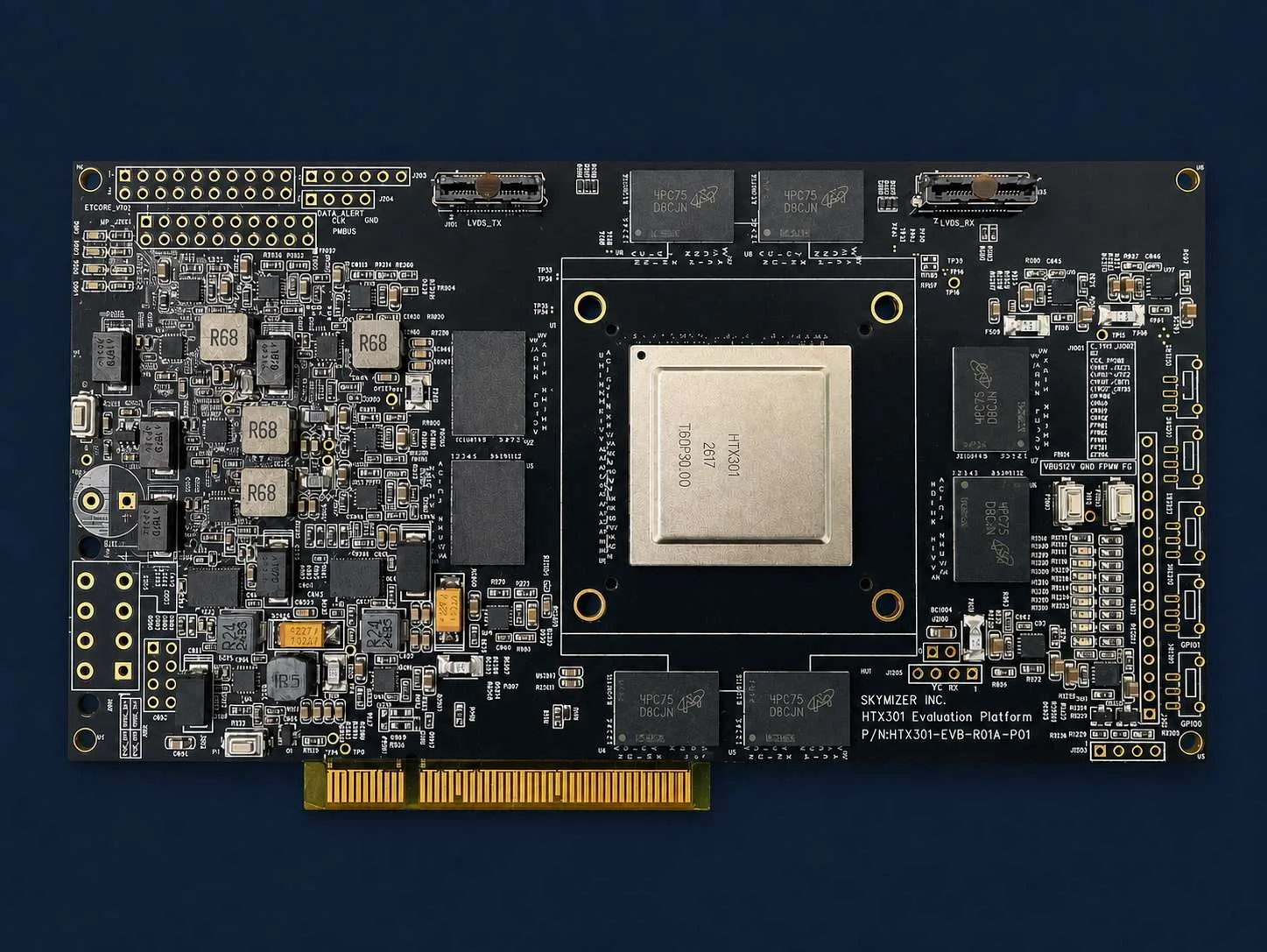
Skymizer Announces HTX301 — Reinventing On-Prem AI Inference
HTX301 enables 700B-parameter LLM inference locally at just ~240W on a single PCIe card — no GPU cluster required.
 Award
Skymizer’s HyperThought™ Wins “Best IP/Processor of the Year” and “Most Promising Product” at EE Awards Asia 2025
Skymizer's HyperThought LLM Accelerator IP receives dual recognition at EE Awards Asia 2025.
 Partnership
Skymizer and JFE Shoji Electronics Join Forces to Advance AI Acceleration Solutions in Japan
JFE Shoji Electronics becomes an official distributor of Skymizer's AI acceleration solutions in Japan.
FAQ
Common questions
What is Skymizer?
Skymizer is an AI inference infrastructure and IP company. It builds decode-first AI inference silicon and LPU IP — HTX301 silicon, the HyperThought™ platform, and EdgeThought™ — for large and ultra-large models, from Edge AI to enterprise on-premise systems and Mini Data Centers.
What is the relationship between HyperThought and HTX301?
HyperThought™ is Skymizer’s decode-first LPU architecture and licensable IP platform. HTX301 is its first productized silicon implementation and accelerator family.
What is decode-first?
Large-model serving has two phases: compute-intensive prefill, and decode, which generates tokens continuously and is dominated by memory capacity, bandwidth, and data movement. A decode-first architecture is built around that sustained token-generation phase rather than repurposing training-oriented silicon.
How large a model can HTX301 run?
The HTX301 platform scales up to eight inference chips and up to 512 GB of DRAM per accelerator, enabling up to ~1-trillion-parameter-class model capacity. Actual memory and model capacity depend on configuration, model architecture, precision/quantization, and software support.
Does HTX301 replace GPUs?
HTX301 reduces dependence on GPU rack-level infrastructure for supported workloads and can complement GPUs in heterogeneous prefill/decode systems. It can operate as dedicated inference infrastructure or as the decode-oriented component of a heterogeneous deployment.
Does Skymizer sell chips or license IP?
Both paths exist: evaluate and deploy HTX301 accelerators for enterprise inference, or license the HyperThought platform — LPU architecture, LISA™ ISA, compiler, runtime, and software — to build your own differentiated AI silicon and systems.
Global reach
Partners & agencies
Skymizer works with regional partners to bring LPU IP and silicon to customers across Asia.




Build the Infrastructure for the Inference Era
From one accelerator to a Mini Data Center. From Skymizer silicon to your own custom AI SoC.